Our Winter hiatus was well-timed! The cold, snow, and ice made Tudor Hall a difficult if not inhospitable place to be. One afternoon, it was 50F inside--much too cold for any serious work to be done. At one point, oil delivery had to be postponed owing to the sheet of ice and snow covering access to the in-ground tank.
Fortunately, Director and Building & Grounds Chair, Mike Mummaugh, fought through the cold and ice. Along with Burch Oil, he got the oil in, diagnosed and fixed a couple of problems, and got the boiler boiling again. We happily settled for 65F and it became absolutely balmy at 68F.
Have no fear - we are open and are keeping the place warm for you!
2025 Annual Appeal: Wow!
Once again, our members and friends, exceeded expectations! Last year's Annual Appeal reached over $42,000. All of us - Directors, Staff, Volunteers - deeply appreciate your thoughtful generosity. While the income is important, indeed essential, for our operations, we also see it as a "vote", if you will, on whether the things we're doing are worthwhile - whether we're making a difference in your appreciation for the history and culture of this wonderful County.
Thank you!
Historically Speaking
On March 26 at the Daugherty-Palmer Commons on the campus of St. Mary's College of Maryland, Mr. David Brown will present George Plater: St. Mary's Forgotten Patriot. The program has attracted considerable interest, particularly from friends of Historic Sotterley Plantation where George Plater lived.
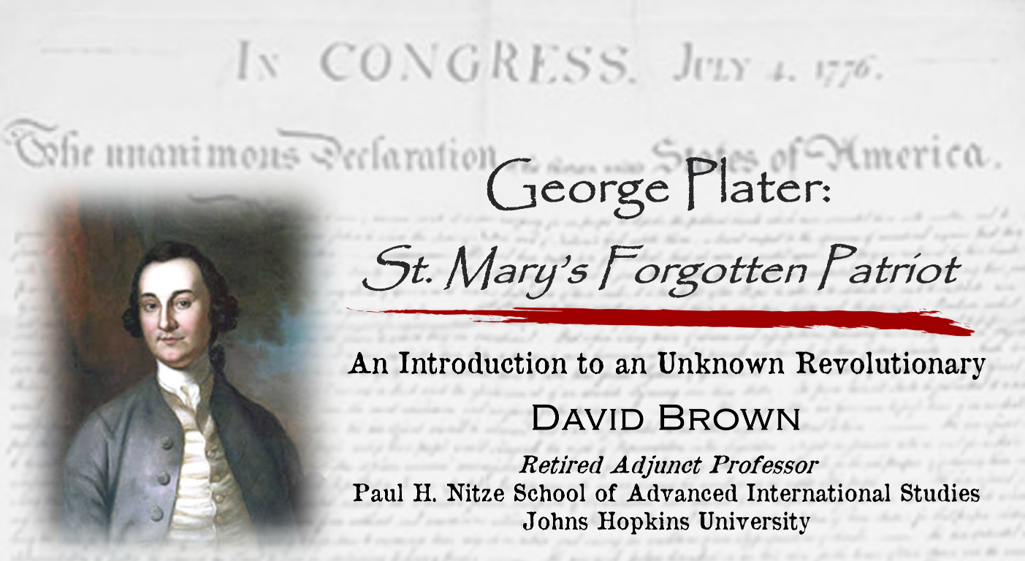
Reservations are strongly recommended (click the underlined link). Mr. Brown's book on George Plater will be available for purchase that evening.
Tudor Hall Engineer Assessment: Draft Findings
We received a draft of the Architectural and Structural Assessment of Tudor Hall done by Building Conservation Associates (BCA). The report, which runs over 100 pages, goes into penetrating detail about the condition of the interior and exterior of Historic Tudor Hall.
Departing from earlier assessments of the historic building, the BCA benefited from the use of advanced technologies for their analysis. Among those used were "LiDAR" (Light Detection and Ranging) an active remote sensing technology that uses laser pulses to measure distances to create high-resolution, 3D "point clouds" of structures, "GPR" (Ground Penetrating Radar) to understand the house’s floor framing, and infrared thermography (IRT) of the exterior and interior walls using a "FLIR" (Forward-Looking Infrared) thermal camera to assess the degree and extent of moisture penetration through the exterior brickwork and interior walls.
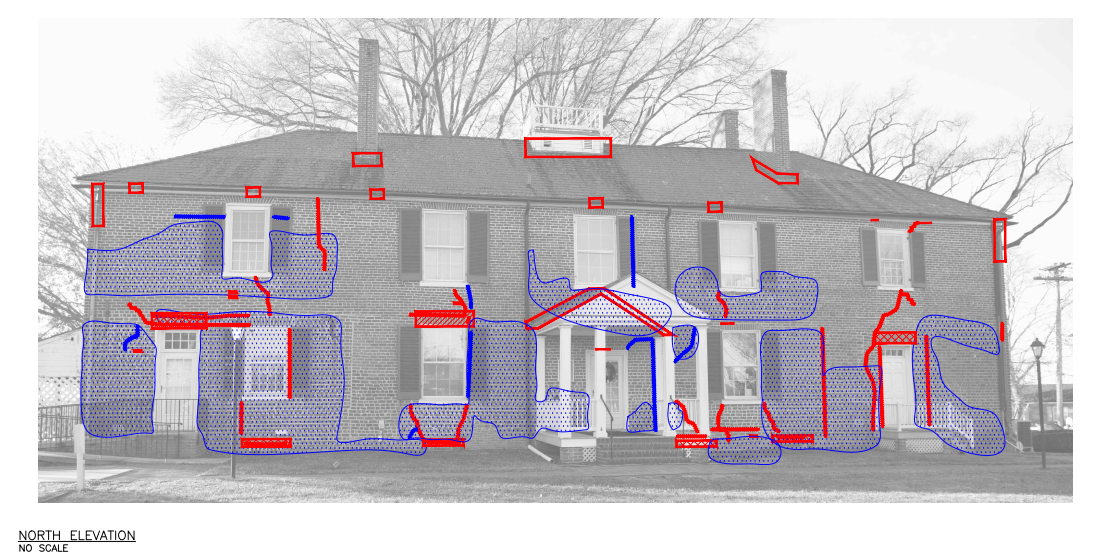
(The marks on the image indicate some of the interior [blue] and exterior [red] areas needing attention on Tudor Hall's North elevation.)
On first read, the draft appears thorough and well-reasoned. Repairs and corrective measures were sequenced as we had requested ranging from immediate to medium- and long-term projects. Taken together, the recommendations might be spaced over five years and are bound to be costly.
After our review of the draft findings, a conversation with the BCA team will follow. Following that, they will issue a final report and we can determine the best way to move forward.
A Tory Congressman
Long-time member and researcher, Jonathan Beasley, has written and published "Tory Congressman Philip Barton Key: Maryland's Revolutionary War". 
Key, the uncle of Francis Scott Key, purchased Tudor Hall in 1817, raised the roof and squared the house out into the 14-room mansion we know today.
The 180-page book is a collection of journal entries from multiple sources. Using a wide range of primary and secondary sources, an with extensive footnotes, the book is a must for both history buffs and professional historians wanting to understand not only the man but circumstances surrounding the Revolution.
The book is currently available at Fenwick Books, the Apple Basket, and Martin’s Service Center in La Plata.
Farewell to a Much Loved Landmark
County residents who live in the Breton Bay area or drive along Bull Road (just off Newtown Neck Road) to the Olde Breton Inn and Breton Bay Golf Course, often glance over at an old, decaying building the "Three Bears House" sitting alone and forlorn in a large, open field. Because of its construction, it was known affectionally as the "Three Bears House".
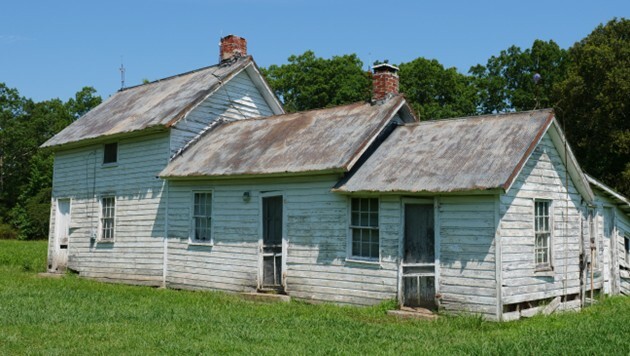 The building, unoccupied since the late 1960s, was recently torn down, marking the loss of another - if not historic - certainly a much loved landmark. We cannot fault the new owners of the property or the adjoining house. The Three Bears House was in an advanced state of decay. Before her passing in 2025 at 101 years old, Mrs. Mary Cusic refused all offers to preserve the building where she and her late husband, Lloyd, had lived for many years.
The Historical Society wrote a three-article history of the building for the County Times a few years back. Just before the building's demolition, those articles were turned into a video of what is known about the land and people who lived in the Three Bears House.
That short, ten-minute video is part of our Stories from St. Mary's County series and can be found both on our website's homepage or at this link.
Past issues of the Tudor Hall Times can be found on our website under Publications